December 10th is Dewey Decimal System Day! Let’s celebrate this important organizational tool by learning more about what it means and why libraries use it.
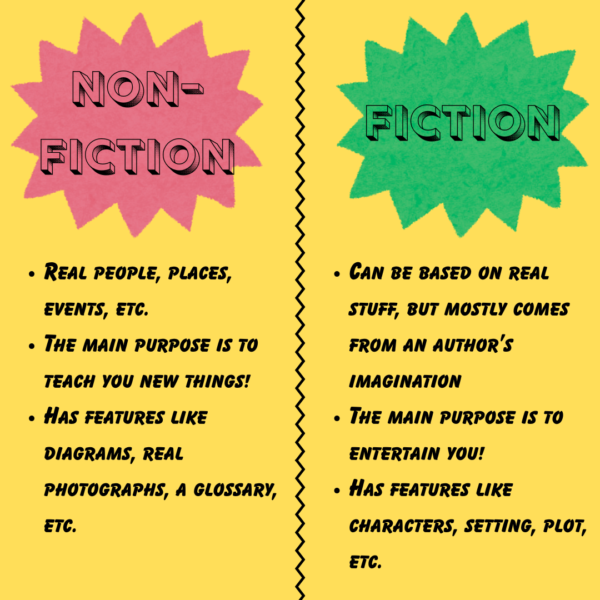
If you’ve spent any amount of time in a library (and we hope you have!), you may have heard librarians referring to “Dewey Numbers” or the Dewey Decimal System. This system helps us organize nonfiction books. Nonfiction is a genre about real people, places, events, etc. For example, topics like George Washington, language, giraffes, and biology are considered nonfiction, but books about unicorns, space zombies, and talking dogs are not.
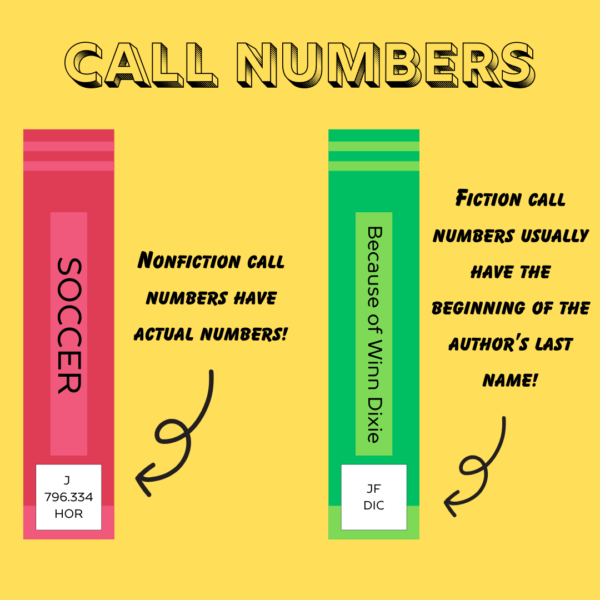
You can verify that a library book is nonfiction by looking at the call number. The call number is a square label, usually located on the bottom of the book’s spine. The labels let us know where the books should be shelved! Nonfiction books have numbers written on them, while fiction books only have letters.
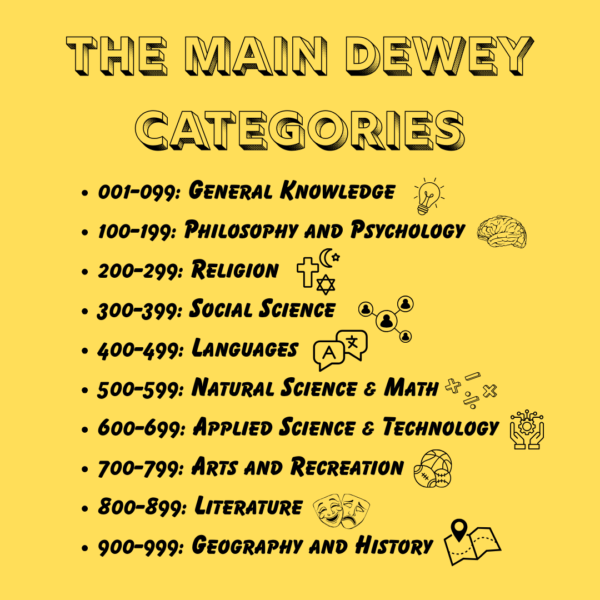
The Dewey Decimal System lets librarians know where nonfiction books should be shelved based on their topic. It was created by Melvil Dewey in 1876–he was also a founding member of the American Library Association! There are ten main categories in the Dewey Decimal System:
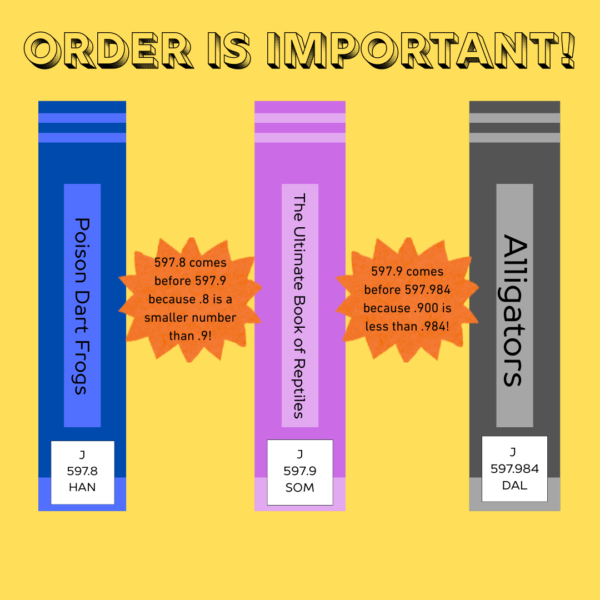
There are also tons of subcategories! For example, cookbooks start at the number 641.5, and books about playing basketball start at 796.323. The numbers help us stay organized because we shelve from least to greatest. For example, a book with the call number 456 would come before a book with the call number 458! If two or more books have the exact same numbers, then we organize them alphabetically by the author’s last name.
The good news is that you don’t need to memorize Dewey numbers! Our online catalog will tell you what numbers to look for based on the topic that you search for, and you can always ask a librarian for help. Stop by your local branch to test your new knowledge and find your next favorite book!